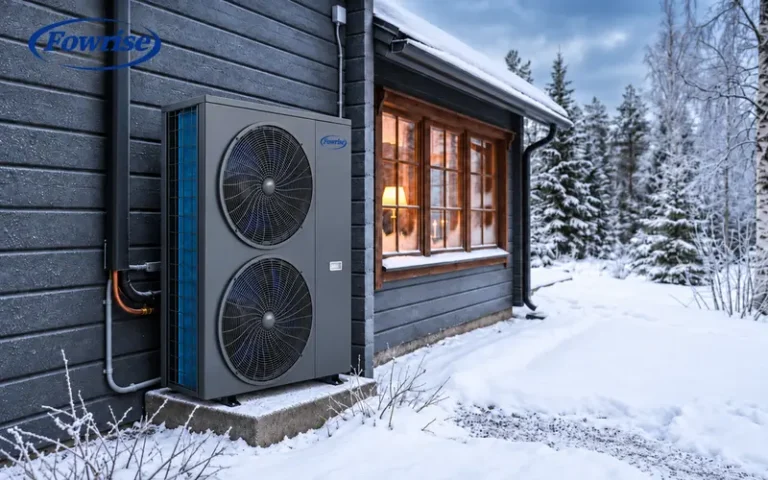
In regions with cold winters, freeze protection is essential not only for the normal operation of an air source heat pump, but also for the reliability of the entire heating system.
In cold climates such as Central Asia and Northern Europe, heat pumps may be exposed to prolonged low temperatures, snowfall, power outages and extended shutdowns.
In practice, some freeze damage is not caused by the heat pump being unable to operate at low ambient temperatures. Instead, it results from inadequate hydronic system design, pipe insulation, drainage arrangements or shutdown procedures.
For contractors and installers, addressing these issues before installation is often more important than dealing with damage after a winter failure.
1. Why Can Heat Pumps Suffer Freeze Damage?
1.1 freezing within the water circuit.
During heating operation, water circulates through the unit’s heat exchanger, connecting pipes, pumps and terminal heating system.
When the outdoor temperature falls below 0°C, water in the system may gradually freeze if circulation stops or if parts of the pipework remain exposed to low temperatures for extended periods.
Water expands as it freezes and may damage pipes, valves, pumps or heat exchangers.
Common causes include:
- A prolonged power outage prevents electrically controlled freeze protection from operating.
- Outdoor water pipes, valves or other hydronic components lack adequate insulation.
- The circulation pump stops, leaving water stagnant for an extended period in freezing conditions.
- Appropriate freeze protection measures were not taken before a long shutdown.
1.2 frosting on the air side.
Air source heat pumps extract heat from outdoor air. Under cold and humid conditions, frost may form on the surface of the outdoor heat exchanger.
Normal frost formation can occur during winter operation and does not necessarily indicate a fault.
However, malfunctioning defrost control, prolonged snow or ice accumulation on the heat exchanger, or poor drainage of defrost water can restrict airflow and reduce heat transfer performance.
Freeze protection for the water circuit and defrosting of the outdoor heat exchanger are therefore separate issues and should not be confused.
2. Maintain Power and Confirm That Freeze Protection Can Operate
For air source heat pumps equipped with automatic freeze protection, maintaining the required electrical supply during winter is important.
When water temperature drops below a preset threshold, some units activate the circulation pump and, when necessary, the compressor or auxiliary heater according to their control logic to reduce the risk of freezing.
An automatic freeze protection function does not mean the unit remains protected during a power outage.
When a unit loses all electrical power, protective measures that depend on electronic controls, pumps or electric heaters generally cannot operate.
Before installing a heat pump in a cold region, contractors should confirm:
- Whether the unit has automatic freeze protection.
- What power supply and operating conditions are required for the protection to function.
- Whether freeze protection remains active when the unit is switched off but still powered.
- Whether the site experiences frequent outages or long periods without supervision.
- Whether additional freeze protection is needed during a power outage.
For winter heating projects, the circulation pump, flow switch and associated safety devices should also be checked.
A heat pump being in standby mode does not, by itself, guarantee that the entire water circuit is protected.
3. Protecting the Water Circuit During Extended Shutdowns or Power Outages
Extended shutdowns require particular attention in freezing conditions.
Schools during holidays, seasonally occupied buildings, temporarily suspended projects and sites with unstable winter power supplies may all leave equipment idle for long periods.
If a system uses plain water as its circulating fluid and has no reliable freeze protection, it may be vulnerable during shutdown.
Contractors should prepare a shutdown protection plan based on the equipment design and site conditions.
3.1 Drain the Water Circuit When Necessary
For systems that will remain shut down for an extended period without other reliable freeze protection, drain the parts of the water circuit exposed to freezing risk in accordance with the manufacturer’s instructions.
When draining, pay particular attention to:
- Whether the internal heat exchanger and low-level pipework can be drained completely.
- Whether residual water remains in pumps, strainers, valves or local low points.
- Whether buffer tanks and outdoor connecting pipes also need to be drained.
- Whether suitable drain and air vent points are provided.
Opening a single drain valve does not necessarily empty the entire system.
Some heat exchangers and complex piping arrangements contain pockets where water can remain. Appropriate measures must follow the equipment manual and the actual hydronic design.
3.2 Do Not Rely on a Fixed Power Outage Duration
Some freeze protection guidance uses a four-hour power outage as a warning threshold.
In reality, the time it takes for a water system to freeze depends on ambient temperature, wind speed, pipe diameter, insulation, water volume and equipment design.
It is therefore incorrect to assume that an outage shorter than four hours is always safe, or that an outage longer than four hours will necessarily cause damage.
Projects in extremely cold areas or locations with frequent outages should incorporate more robust protection at the system design stage.
4. Do Not Overlook Outdoor Pipe Insulation
Incomplete insulation of outdoor water pipes is an important issue for installers to check.
Even when a heat pump is rated for low ambient temperature operation, exposed outdoor pipes, valves, strainers and connections may still be vulnerable to freezing.
The risk increases with long pipe runs, sections with low water flow or prolonged equipment shutdowns.
Key areas to inspect during installation include:
1.Outdoor supply and return pipes
Select insulation materials and thicknesses based on the local minimum design temperature, pipe dimensions and operating conditions.
2.Valves, flanges and fittings
These areas are sometimes left inadequately insulated because access and installation are more difficult.
3.Pumps, strainers and other hydronic components
Provide suitable insulation and protection while maintaining the access required for inspection and maintenance.
4.Insulation joints and outdoor protection
Check that joints are properly sealed and consider weatherproofing, UV resistance and mechanical protection as appropriate for the site.
Where the risk of freezing is high, a suitable electric heat tracing system may be required.
Heat tracing also depends on electrical power and must not be treated as protection that will necessarily remain available during an outage.
5. Is Antifreeze Necessary in the Water Circuit?
Antifreeze is one possible freeze protection measure in cold regions, but it is not mandatory for every air source heat pump system.
The decision should reflect the local climate, system configuration, equipment requirements and the risks associated with shutdowns and power outages.
Common options include ethylene glycol or propylene glycol formulations intended for HVAC hydronic systems.
Several points require particular attention.
5.1 Confirm Equipment and Material Compatibility
The antifreeze fluid must be compatible with the heat exchanger, pumps, seals, piping and other system materials.
Use fluid types and formulations approved by the equipment manufacturer wherever possible.
5.2 Select the Concentration for the Design Temperature
Do not add antifreeze at an arbitrary fixed concentration.
Determine the concentration based on the project’s minimum design temperature, the fluid manufacturer’s performance data and the required level of freeze or burst protection.
5.3 Recalculate Hydronic System Performance
Compared with plain water, ethylene glycol and propylene glycol solutions have different specific heat capacities, viscosities and heat transfer properties.
Using antifreeze may affect flow rate, pump head requirements, heat transfer capacity and overall unit performance.
Contractors should therefore recalculate the hydronic system using the actual glycol concentration rather than applying all design values from a water-only system.
5.4 Plan for Maintenance
Check antifreeze concentration, condition and service life in accordance with the fluid manufacturer’s recommendations.
For domestic hot water or other applications with specific fluid safety requirements, confirm the system separation arrangements and applicable safety requirements.
A higher antifreeze concentration is not automatically better, and antifreeze does not replace sound hydronic design or equipment protection.
6. Remove Snow and Check Defrost Water Drainage
Frost formation on the outdoor heat exchanger is common when an air source heat pump operates in heating mode during winter.
Under normal conditions, the unit initiates automatic defrost cycles according to its control logic.
However, persistent snowfall, cold and humid weather or poor drainage can create additional problems.
6.1 Keep Airflow Paths Clear
Maintain the required clearances for air intake, discharge and maintenance in accordance with the installation instructions.
Remove snow and debris that could obstruct the airflow around the unit.
6.2 Ensure Defrost Water Can Drain Properly
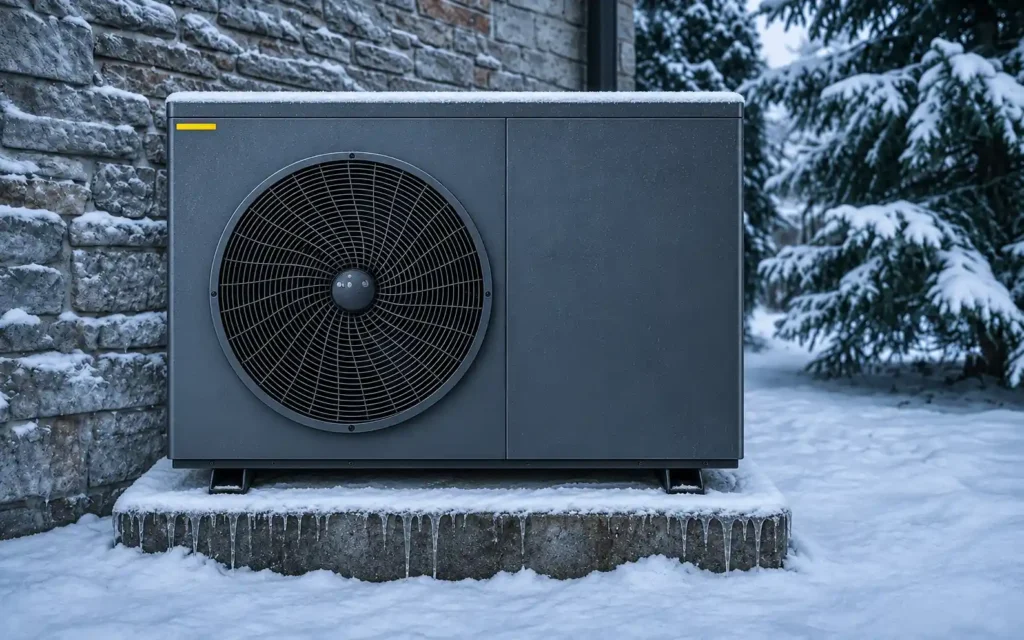
Water produced during defrosting may refreeze beneath the unit or on surrounding surfaces if it cannot drain away.
Ice buildup over time can affect drainage, equipment servicing and pedestrian safety.
In cold regions, installation planning should consider:
- The height of the unit’s mounting base.
- The route for discharging defrost water.
- Freeze protection for drainage pipes.
- Whether the discharge location is prone to ice accumulation.
Base height and drainage details should be determined from the unit design, local snowfall conditions and the manufacturer’s installation requirements.
6.3 Do Not Mistake Normal Frost for a Fault
Frost on the heat exchanger in cold, humid conditions is not necessarily abnormal.
Further investigation is appropriate if:
- Frost remains for unusually long periods.
- Significant abnormal ice remains after a defrost cycle.
- Heating capacity decreases noticeably.
- Defrost frequency or duration becomes abnormal.
- The unit displays a defrost-related fault alarm.
Check sensors, control logic, fan operation, airflow and refrigerant system condition rather than diagnosing a fault solely from the presence of frost.
7. Pre-Winter Inspection Checklist for Contractors and Installers
Before the heating season begins, a complete inspection of the air source heat pump system is recommended.
| Inspection Item | What to Check |
| Electrical supply | Power supply stability and availability of power required for freeze protection |
| Automatic freeze protection | Whether control logic and protection functions meet the equipment requirements |
| Hydronic circulation | Pumps, flow rate, strainers and associated protective devices |
| Outdoor pipework | Integrity of insulation and exposed valves or fittings |
| Antifreeze fluid | Type, concentration and condition, where antifreeze is used |
| Drainage | Whether defrost water drains freely and whether the route may freeze |
| Unit surroundings | Clear air intake and discharge, with no obstructing snow or debris |
| Shutdown management | An established procedure for extended shutdowns and power outages |
For cold-region projects, freeze protection, power outage response and long-term shutdown procedures should be included in the handover and operator training.
Conclusion: Low Ambient Temperature Operation Does Not Mean the Entire System Is Freeze-Proof
A heat pump’s ability to operate at low ambient temperatures does not mean every hydronic component is protected against freezing under all shutdown conditions.
The operating temperature range, automatic freeze protection, pipe insulation, antifreeze fluid and site installation conditions must be considered together as a complete system.
For contractors and installers, confirming the local minimum design temperature, power supply reliability, pipe routing and shutdown arrangements in advance can help reduce freeze damage and subsequent maintenance problems.
FOWRISE supplies air source heat pumps and provides project selection support. For heating projects in cold regions, we can discuss equipment configurations and hydronic freeze protection requirements based on the actual operating conditions.
If you are selecting an air source heat pump for a cold-climate project, share the project location, minimum design temperature and system type so that the equipment selection and freeze protection approach can be assessed further.
Technical note: This article provides general guidance for engineering design, installation and maintenance. It does not replace the installation manual for a specific model. Freeze protection logic, permitted antifreeze fluids, drainage procedures and maintenance requirements must follow the applicable equipment documentation.